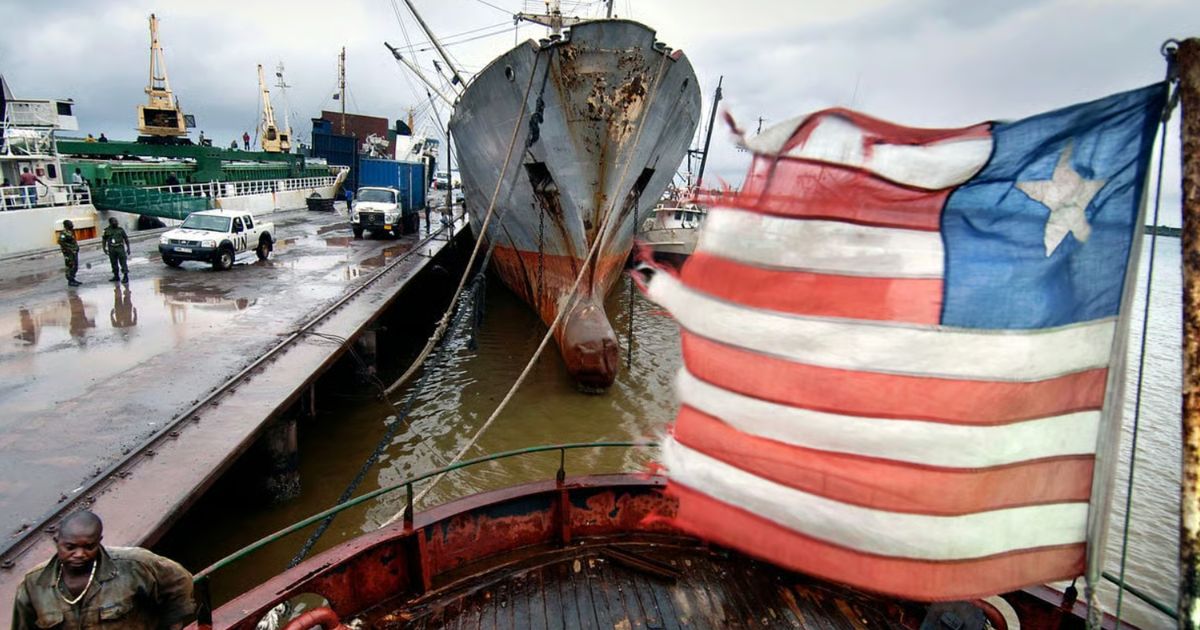
When tensions escalated once again in the Strait of Hormuz this week, one country's flag appeared repeatedly on some of the world's largest oil tankers - not the United States, the United Kingdom or China, but Liberia. Read Also According to S&P Global MINT and S&P Global Commodities at Sea, at least six Liberian-flagged vessels were among the ships transiting the strategic waterway on July 7, including multiple Very Large Crude Carriers (VLCCs) carrying millions of barrels of crude oil. One of them, the CYPRUS PROSPERITY, was among the commercial vessels reportedly targeted during the latest escalation in the Gulf. For a country of just over 5 million people with a relatively modest domestic shipping industry, Liberia's prominence in one of the world's busiest maritime corridors raises an obvious question: How did a small West African nation become one of the world's biggest names in global shipping? The answer has little to do with the number of ships Liberians own, but everything to do with the country's ship registry.
Liberya'nın Denizcilik Gücü Nasıl Bir Yapıya Dayanıyor?
A maritime giant built on registration, not ownership Despite its size, Liberia operates one of the world's largest ship registries, allowing shipowners from around the world to register their vessels under the Liberian flag regardless of where they are based. The arrangement, known as an open registry or flag of convenience, has transformed Liberia into one of the world's leading flag states. Under international maritime law, every commercial vessel must be registered in a country and fly that country's flag. The flag state is responsible for enforcing safety standards, environmental regulations and compliance with international shipping conventions. Crucially, however, a vessel's flag does not indicate who owns the ship, where it was built or where its cargo is headed.
A tanker flying Liberia's flag may be owned by a Japanese company, managed from Greece, carrying Saudi crude to South Korea and financed by investors in Europe. This distinction has enabled Liberia to become a maritime heavyweight without owning one of the world's largest merchant fleets. Liberia's presence in the world's most strategic shipping lane The latest Strait of Hormuz transit data illustrates just how significant Liberia's registry has become. S&P Global recorded 47 vessel transits through the Strait on July 7, despite heightened regional tensions following attacks on commercial shipping. Among the African registries represented, Liberia accounted for the largest number of vessels, with six ships flying its flag.
Liberya Bayraklı Gemilerin Özellikleri Nelerdir?
They included: CYPRUS PROSPERITY , VLCC (Outbound) TOGO PROSPERITY , VLCC (Outbound) DAS , VLCC (Outbound) KERALA , Product Tanker/LR1 (Inbound) SEA GULL , Product Tanker/MR (Outbound) AL RIDEEM , Bulk Carrier/Supramax (Inbound) By comparison, Comoros appeared three times in the transit data, while Gabon was represented by one vessel. The significance extends beyond the numbers. According to S&P Global, the Liberian-flagged CYPRUS PROSPERITY was among the commercial vessels targeted on July 7 after loading crude from Abu Dhabi's Das Island. The attacks came as shipping companies faced growing security concerns in one of the world's most critical energy corridors. Despite the escalating tensions, overall vessel traffic remained resilient.
S&P Global reported that total crossings through the Strait remained broadly unchanged from the previous day, although shipping behavior shifted noticeably. About 36% of vessels transited with their Automatic Identification System (AIS) signals switched off, compared with a July average of 21%, reflecting heightened caution among shipowners navigating the region. Why the world's largest tankers choose Liberia Liberia's influence in global shipping is built on more than its open registry - it is also one of the world's most respected maritime administrations. Today, the Liberian Registry includes more than 5,650 ships with a combined 277 million gross tons (GT), representing approximately 17% of the world's ocean-going fleet, according to Clarkson's World Fleet Register.
Kaynak: Business Insider Africa